The Math Says CEOs Cannot Stop Themselves: Inside the AI Layoff Trap
- David Borish

- Apr 13
- 9 min read
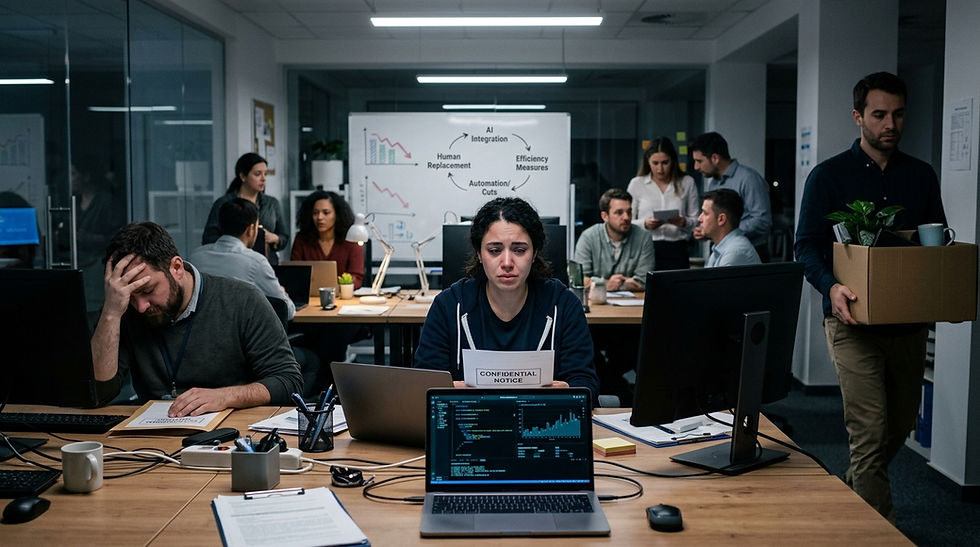
A new theoretical economics paper from Brett Hemenway Falk at the University of Pennsylvania and Gerry Tsoukalas at Boston University arrives at a conclusion that should unsettle anyone watching the current wave of AI-driven layoffs. Working from a competitive task-based model in the tradition of Acemoglu and Restrepo, the authors prove that rational firms with perfect foresight will automate well past the point where doing so harms their own profits. The race is not a misunderstanding. It is a dominant strategy.
The paper, titled "The AI Layoff Trap" and dated March 2, 2026, was posted to arXiv on March 21. It opens with a question that has been hovering over the economics of AI for the past two years: if firms can see that mass automation will erode the consumer demand they depend on, why are they accelerating into it anyway? The authors' answer is that visibility alone changes nothing. Each firm's individual incentive to automate exists regardless of what other firms do, and the structure of the game makes voluntary restraint impossible.
The Mechanism
The model is deliberately stripped down. A sector contains some number of symmetric firms, each with a workforce performing tasks that can be replaced by AI at lower cost. Each firm chooses what fraction of its workers to displace. Workers spend a portion of their wages on the sector's output. When a firm automates, the displaced workers lose income, and a fraction of that lost income would have flowed back into the sector as consumer spending. The demand that firm destroys is shared across all firms in the market, but the cost savings it captures are entirely its own.
This asymmetry is the entire trap. A firm that automates one task saves the full wage but bears only one-Nth of the resulting demand loss, where N is the number of firms in the sector. The remaining demand loss falls on rivals. Each firm's first-order condition therefore understates the social cost of its own decision. The authors prove that automating at this privately optimal rate is a strictly dominant strategy. It does not depend on what rival firms do. It does not depend on whether firms can communicate. It does not depend on whether they understand the consequences.
The wedge between the privately optimal automation rate and the cooperatively efficient rate grows with the number of competitors. A monopolist fully internalizes the externality and automates at the right level. As markets fragment, each firm's share of the demand loss shrinks, and the gap widens. In the frictionless limit, where every task is equally easy to automate, the game collapses into a Prisoner's Dilemma with a unique equilibrium: every firm displaces its entire human workforce, even though collective restraint would leave everyone better off.
The AI Layoff Trap
The most consequential finding in the paper is that over-automation is not a transfer from workers to firm owners. It is a deadweight loss that harms both. The authors prove this formally. Workers lose wage income through displacement. Firm owners save on labor costs but suffer revenue declines large enough to push their equilibrium profits below what they would earn under cooperative restraint. The Nash equilibrium is Pareto dominated by the cooperative optimum. Both factor classes would prefer the world in which firms collectively automate less.
This result matters because it eliminates the standard framing of the automation debate as a fight between capital and labor. The paper shows that even a planner who places zero weight on workers, who cares only about aggregate profit, would still want to reduce automation. The demand externality alone, before any concern for distribution, is enough to justify intervention.
The Real-World Cases
The authors anchor their abstract model in concrete events. They cite Block's February 2026 decision to cut nearly half of its 10,000-person workforce, with CEO Jack Dorsey stating that AI had made many of the roles unnecessary and predicting that within a year most companies would reach the same conclusion. They note that more than 100,000 tech workers were laid off in 2025, with AI cited as a primary driver in over half the cases.
Salesforce replaced 4,000 customer-support agents with agentic AI. Cognition's Devin, deployed at Goldman Sachs and Infosys, allows one senior engineer to do the work of a five-person team. Eloundou and coauthors estimate that roughly 80 percent of U.S. workers hold jobs with tasks susceptible to large language model automation.
The point of these citations is not to catalog the damage. It is to establish that the mechanism the paper describes is already operating. None of the firms involved are acting irrationally. They are responding to the competitive incentives the model identifies, which means the wave will continue regardless of public pressure or executive misgivings.
Six Policies, One That Works
The bulk of the paper evaluates proposed responses to AI displacement. The authors consider six instruments and ask a single question of each: does it operate on the per-task automation margin where the externality lives? Most do not.
Universal basic income raises the floor on living standards but enters firm profits only as a constant term in the baseline. It does not appear in the first-order condition that determines automation rates. UBI changes payoff levels without changing the strategic incentive. The same logic applies to capital income taxation. A proportional tax on profits scales the entire profit function but cancels out of the optimization, leaving the equilibrium automation rate unchanged. Both instruments can redistribute the spoils. Neither can stop the over-automation.
Worker equity participation does better. When workers hold stakes in firm profits, part of the demand lost through displacement gets recycled back into spending, and each firm perceives a larger effective demand loss from its own automation. The wedge narrows. But it cannot close unless workers receive more than 100 percent of profits, which is mathematically impossible in any feasible regime. The authors also show that no firm would choose to share profits voluntarily, since the cost of sharing strictly exceeds the demand benefit.
Coasian bargaining fares no better. Worker-side bargaining can reach the income-replacement parameter but cannot touch the cross-firm channel through which the externality actually flows. The harmed parties are not the displacing firm's own workers. They are the rival firms whose revenues fall as displaced workers stop spending. Firm-to-firm bargaining could in principle target the right margin, but the authors show that any partial coalition leaves the externality uncorrected, and the grand coalition cannot form because automation is a dominant strategy. No voluntary agreement is self-enforcing.
The only instrument that survives is a Pigouvian automation tax. A per-task charge equal to the share of demand loss that each firm currently externalizes onto rivals brings private incentives back into alignment with social cost. For large numbers of firms, the optimal rate approaches the demand loss per displaced worker, which depends only on sector-level observables. The tax can be set without observing any individual firm's books. Levying it requires firm-level automation data, which the authors note is increasingly available through procurement records and payroll filings.
The Red Queen Effect
One of the paper's more counterintuitive findings concerns AI productivity. A common response to displacement worries is that more capable AI will resolve the problem by expanding the economic pie. The authors prove the opposite. When AI not only replaces workers but produces more output per task, each firm sees a market-share gain from automating faster than rivals. At the symmetric equilibrium these gains cancel, since all firms expand equally. What remains is the additional distortion. Better AI widens the wedge rather than closing it.
The authors call this a Red Queen effect, after the character in Lewis Carroll who has to keep running just to stay in place. As AI capability improves, the cost saving per automated task grows, the market-share competition intensifies, and the over-automation wedge expands. The cooperative optimum does not change, but the equilibrium drifts further from it.
Endogenous wage adjustment, the standard self-correcting mechanism in Acemoglu-Restrepo style models, raises the threshold at which the externality activates but cannot eliminate it. Free entry, capital-income recycling, and richer product-market structures fail similarly. The externality survives every generalization the authors test.
Where the Trap Meets the Curve
The Falk-Tsoukalas model gives a clean account of why firms over-automate, but the model's parameters are deliberately abstract. The cost saving per automated task, the demand loss per displaced worker, the friction parameter, the number of competitors. Plug in real numbers and the trap stops being a thought experiment.
I have been tracking those real numbers since early 2025 in the Exponential Replacement Curve, a framework I built on METR's task time-horizon research, the Open-Prem Inflection Point analysis, and David Sacks' projections on multiplicative AI growth. The second edition, published in June 2025, updated the AI capability doubling rate from METR's original 7-month estimate to 5.5 months based on production deployments including Claude 4 and Rakuten's 7-hour autonomous code refactoring run.
Two findings from the V2 paper map directly onto the variables in the Falk-Tsoukalas model. The first is the cost gradient. For knowledge work, human labor runs $50 to $200 per hour fully loaded, while AI runs $0.10 to $1.00 per hour by late 2026. For physical labor, human costs run $15 to $50 per hour, while humanoid robot operational costs approach $5 to $10 per hour by 2026. In the Falk-Tsoukalas notation, this is the cost saving per automated task, and it is enormous. The second is the income replacement rate, the parameter the authors call eta. The V2 timeline projects three waves of displacement, with first-wave workers facing 6 to 12 months of runway, second-wave workers 12 to 18 months, and third-wave workers 18 to 24 months. Across all three waves, the displaced workers move into a labor market where AI capability is doubling every 5.5 months. The reabsorption channel that historically pushed eta toward unity is structurally unavailable when the next wave arrives before the previous one has resettled.
This is precisely the regime in which the Falk-Tsoukalas trap bites hardest. Their model shows that the over-automation threshold drops to roughly one as AI costs approach zero, which means the trap activates in essentially any market with two or more competitors. The V2 cost data shows that AI costs are already two to three orders of magnitude below human costs in knowledge work. The threshold has been crossed. And because the V2 timeline puts mass adoption of physical robotics in structured environments at Q4 2025 and semi-structured environments at Q1 2027, the trap is about to activate in sectors that employ tens of millions of workers: 12.2 million in food service, 4.6 million in retail, 3.7 million in delivery, 1.8 million in warehousing, 2.4 million in agriculture.
The Red Queen finding in the Falk-Tsoukalas paper deserves particular attention in light of the V2 doubling rate. Their proof shows that higher AI productivity widens the over-automation wedge rather than closing it. The V2 paper documents that the productivity parameter is not static. It is doubling every 5.5 months. Each doubling pushes the wedge wider, the threshold lower, and the cooperative optimum further from the equilibrium that competitive markets actually reach. The two frameworks are not just compatible. They describe the same phenomenon from opposite directions, and they amplify each other.
What the Paper Implies
The policy implication is direct. Reactive measures that take care of displaced workers after the fact are necessary but insufficient. They do not change the incentives that drive the displacement in the first place. Correcting the trap requires an instrument that operates on the per-task automation margin, and the only such instrument the authors find is a tax.
The authors are careful about scope. They evaluate each instrument against a single distortion, the demand externality, while holding other features of the economy fixed. They do not weigh administrative costs, political feasibility, or labor-market effects outside the model. They acknowledge that measuring firm-level automation rates is harder in practice than in theory. The paper is a theoretical contribution, not an implementation guide.
But the core result is robust enough to reframe how the policy debate should be conducted. UBI and capital income taxes can no longer be discussed as solutions to the demand consequences of automation. They address different problems. Profit-sharing and retraining programs can shrink the externality but cannot close it. Voluntary corporate restraint is mathematically unavailable, regardless of how many CEOs sign open letters about responsible AI. The only mechanism that fully corrects the distortion is a per-task levy on automation, and the revenue from that levy is best directed toward retraining programs that raise the income-replacement rate over time, making the tax progressively smaller.
The deeper observation in the paper is that the demand externality from AI sits in a category economists have understood for nearly a century. It belongs to the same family as the aggregate demand spillovers that Rosenstein-Rodan and Murphy, Shleifer, and Vishny analyzed in their work on big-push development. The mathematical machinery has been available since the 1940s. What the authors have added is the mirror image: instead of individually unprofitable investments that would be collectively profitable if coordinated, they describe individually profitable automation that is collectively destructive. The structure is symmetric. The remedy is symmetric too. It just runs in the opposite direction.