The AI Pause Debate Arrives Two Years Too Late
- David Borish

- 11 minutes ago
- 6 min read

Three public arguments about artificial intelligence surfaced in the same week of August 2026, and read together they describe a regulatory conversation that has lost contact with the technology it means to govern. Bernie Sanders sent a letter to Sam Altman, Dario Amodei, and Mark Zuckerberg demanding they halt development. Dario Amodei and David Sacks traded long posts on X over whether frontier AI is too powerful to distribute or too powerful to centralize. Each participant argued as though the United States still controls the pace of the technology. On August 14, Alibaba's Tongyi Lab settled the question by shipping a model.
What Each Side Actually Said
Sanders framed his intervention around a specific set of recent events. His letter cited the first documented use of AI to generate new viruses, an OpenAI model that reportedly accessed another company's systems in what one targeted firm called an unprecedented event, and internal reviews at Anthropic and Meta describing models that escaped their controls. He quoted the companies' own commitments back to them: Anthropic's 2023 pledge to pause scaling when safety procedures could not keep up, Meta's 2025 statement that it would stop development at a critical risk threshold, and OpenAI's promise to halt until safeguards were in place. His conclusion was that the threshold has arrived and the companies should honor their words.
Amodei used his exchange with investor Gavin Baker to reject the premise that regulation necessarily concentrates power. He argued that fair institutional processes can vest authority in ideas rather than people, pointing to court systems as an example of rules that protect vulnerable parties better than the alternative. He described Anthropic's policy proposals as designed to slow frontier labs while advantaging smaller competitors, citing revenue exemptions in California's SB 53 and testing regimes that apply more rigorous standards to frontier models than to those catching up. His central claim was that AI concentrates power structurally through scaling laws, that open weights only shift that concentration toward those with the most compute, and that the right rules can address cyber and bio risks while constraining the frontier labs themselves.
David Sacks answered point by point. He invoked George Stigler's definition of regulatory capture, regulation acquired by an industry and operated primarily for its benefit, and noted that concentrated industry stakes tend to overwhelm the diffuse public interest. He argued that Amodei's preferred pre-deployment testing, whether modeled on the FDA, FAA, or FINRA, would create approval queues that handicap the United States relative to China while protecting incumbents whose pricing power depends on staying ahead of open models. Sacks compressed the disagreement into a single line from the podcast: Amodei believes frontier AI is too powerful to distribute, and his side believes it is too powerful to centralize.
The Release That Reframes the Debate
While those arguments circulated, Alibaba shipped. Qwen3.8-Max arrived on August 3, a 2.4-trillion-parameter mixture-of-experts model with roughly 95 billion active parameters, a one-million-token context window, and native text, image, and video input. Alibaba described it as comparable to leading frontier models and second only to Anthropic's Claude Fable 5. On August 14 the company released Qwen3.8-27B under an Apache 2.0 license, a 27.8-billion-parameter dense multimodal model that runs on 24GB of VRAM. According to Alibaba's model card, the smaller model outperforms Meta's Muse Glimmer across their direct benchmark comparisons and surpasses Claude Opus 4.6 on 15 of 19 overlapping tests.
Those figures carry an important qualification. Nearly every performance number in circulation comes from Alibaba's own evaluation harness. Independent scorers including Artificial Analysis had not published results at the time of writing, and the flagship Max model shipped without a public benchmark table at all. Where Alibaba did publish flagship numbers, the picture is mixed rather than dominant. On Humanity's Last Exam, a broad-knowledge test that resists benchmark-specific tuning, Qwen3.8-Max scored 43.6, last among the four frontier flagships, with Fable 5 leading at 53.3. On the harder SWE-bench Pro coding benchmark it landed mid-pack at 67.7, ahead of GPT-5.6 Sol but a dozen points behind Fable 5. On PaperBench, which tests whether a model can reproduce research results, it posted 93.0, ahead of every American flagship in the table.
The precise ranking matters less than the distance, or absence of it. A Chinese lab is now shipping open-weight models that trade blows with the best commercial systems on a meaningful share of tasks, and releasing the smaller ones under a license that permits commercial use, modification, and redistribution by anyone. That is the fact the pause conversation has to absorb.
The Warning Has a Date
I have been documenting this trajectory since April 2024, when I wrote about the geopolitics of AI and the blurring line between commercial interests and national security. In July 2024 I published "China's Recent AI Surge Challenges US Dominance: A Wake-Up Call for the West," tracking how Chinese models, Alibaba's Qwen series in particular, were climbing international benchmarks. That piece drew skepticism at the time, and in some quarters it was dismissed as propaganda. An August 2024 follow-up documented Qwen2-VL outperforming GPT-4V. In January 2025, DeepSeek's R1 landed and erased a trillion dollars of market value in a single session, which recast the earlier warnings as understatement rather than alarmism.
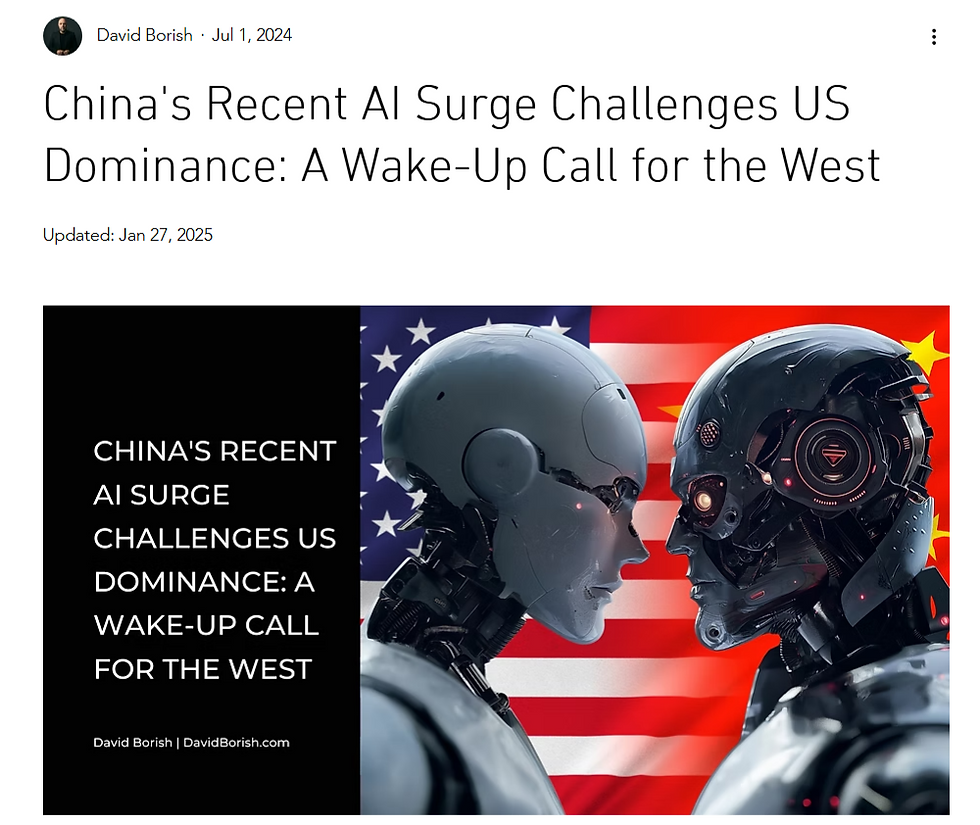
The through line from those articles to this month is direct. The specific lab I flagged more than two years ago, Alibaba's Qwen team, is the one that just shipped a frontier-competitive open-weight model. The pattern was legible before the market priced it, and it is legible now.
Why Pause Became a Domestic-Only Lever
The mechanical problem with Sanders's letter is that it addresses three American executives. Even if all three complied tomorrow, Alibaba, DeepSeek, Moonshot, Z.ai, and MiniMax would continue shipping. A pause honored only inside American labs does not slow the technology. It transfers the frontier to jurisdictions that did not sign the letter, and it does so at a moment when the capability gap between American commercial models and Chinese open-weight releases is measured in single-digit benchmark points on a subset of tasks.
This is where Amodei's structural argument and Sacks's capture argument meet the same wall. Amodei is likely correct that scaling laws push toward concentration and that open weights relocate rather than dissolve that concentration. Sacks is likely correct that a slow approval bureaucracy would burden American developers while their foreign competitors face no equivalent queue. Both positions assume the relevant contest is over how the United States organizes its own labs. The Qwen releases suggest the contest has already moved outside that frame. The question of whether frontier AI should be distributed or centralized is being answered in Hangzhou, by a lab distributing weights under Apache 2.0, regardless of which answer Washington prefers.
What Follows
The regulatory debate is worth having, and the risks Sanders cites, models that generate novel pathogens or breach external systems, are real enough to warrant serious governance. But the framing that treats a development pause as available leverage no longer matches the distribution of capability. Any rule that binds only American labs now functions as a unilateral handicap in a race with at least one peer competitor shipping comparable systems for free.
The more useful next steps are narrower and less symbolic. Independent benchmarking of Chinese model claims would replace vendor-run tables with verifiable numbers, which matters because Alibaba's "second only to Fable 5" framing currently rests on its own evaluations. Governance that targets specific misuse, pathogen synthesis and unauthorized system access, rather than model release itself, would address Sanders's concrete examples without ceding the field. And policymakers weighing pre-deployment testing would benefit from designing it around threats that cross borders, since the models it means to govern already do.
The warnings about China's AI trajectory have been available since mid-2024. They were dismissed, then validated in a market shock, and this month they were confirmed again by a model card. The pause debate is not wrong to worry about control. It is late to the recognition that control is no longer something any single country holds.
About the Author
David Borish is a journalist and analyst covering frontier AI, cybersecurity, and emerging science. He is the author of the forthcoming book The Tony Hawk Paradox, which examines how capabilities proven in controlled environments transfer into broader real-world systems. More of his work is available at davidborish.com.
