Precision Nutrition's AI Moment: A New Framework Aims to Fix What's Broken

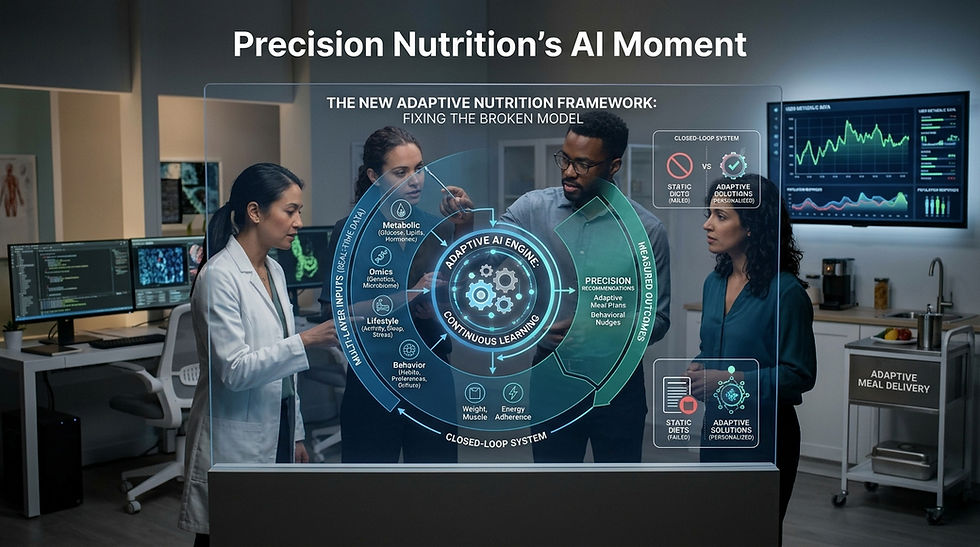
Nutritional deficits contribute to nearly 50 million disability-adjusted life years and account for 26% of all adult deaths worldwide. A third of premature deaths in the United States trace back to nutrition-associated factors, including limited diet diversity, elevated body mass index, high blood pressure, and sedentary behavior. Those figures open a new Perspective in Nature Communications from a team spanning Cornell's Joan Klein Jacobs Center for Precision Nutrition and Health, UC San Diego, and Weill Cornell Medicine, and they set up the paper's central argument. Current dietary guidelines are built for populations, not for the person sitting across from a dietitian, and they don't capture how differently two people can respond to the same meal.
That variability isn't hypothetical. In one randomized crossover trial cited in the paper, researchers built a microbiome-based machine learning model that predicted, for each individual, which bread type would produce a smaller blood sugar spike. Across independent cohorts, a person's gut microbiome and other individual factors have outperformed a meal's macronutrient content when it comes to predicting glycemic response. That's the promise of precision nutrition: tailoring guidance to biology and behavior instead of averages. The paper's contribution is a sober accounting of what it will actually take to get AI models to deliver on that promise, and a checklist meant to hold researchers to it.
The data problem underneath the algorithm problem
Before any model gets built, the authors argue, the data itself creates problems that generic AI practices weren't designed to handle. Dietary intake data is episodic and compositional, collected through recalls, food frequency questionnaires, diet records, and apps that each introduce their own error patterns. Different studies rely on different food composition databases and nutrient calculation software, and the paper notes that this alone can produce meaningfully different nutrient totals even when the underlying foods reported are the same. Wearables and continuous glucose monitors generate high-frequency time series with irregular sampling and time zone inconsistencies. Microbiome data carries its own noise, with low-coverage taxa and results that vary by sequencing platform, DNA extraction method, and whether researchers use relative or absolute abundance.
Even large, well-funded biobanks aren't immune. The All of Us Research Program applies the OMOP Common Data Model for standardization, but the paper points out that electronic health record measurements still show unit inconsistencies, such as HbA1c reported as a percentage in one source and mmol/mol in another, and that biomarkers central to precision nutrition, like omega fatty acids and inflammatory markers, aren't routinely collected outside of sub-studies. Harmonization has to happen before a model ever sees the data, through unified reference databases, controlled vocabularies, and consistent handling of batch effects from sequencing runs or processing timelines.
Where the different model types actually help
The paper works through three families of methods and is fairly disciplined about matching each to what it's good for. Traditional machine learning, things like LASSO, ridge regression, and random forests, remains valuable for smaller or structured datasets because it's interpretable and statistically well understood. Gradient boosted trees have performed particularly well in this space: one cited study used gradient-boosted models integrating gut microbiome features with diet and clinical data to predict postprandial glycemic response with a correlation of 0.77, a notably strong result for this kind of biological prediction.
Deep learning earns its place in multimodal integration, using convolutional networks for food image recognition, recurrent networks for wearable time series, and graph neural networks to model relationships between microbes and metabolites. A model called MiMeNet, for example, learns mappings from microbial taxa to metabolite profiles to help identify the biological pathways connecting diet, microbiome, and health outcomes. The tradeoff is that deep learning needs large labeled datasets and heavy compute, and its internal reasoning stays largely opaque even when tools like SHAP or Grad-CAM offer partial explanations after the fact.
Large language models get the most cautious treatment. They've been used for personalized food recommendations and for building diet plans for conditions like type 2 diabetes and kidney disease, and retrieval-augmented generation has helped ground those recommendations in actual nutrient databases rather than a model's internal guesses. But the paper is direct about the risks: hallucination, training data leakage that shows up as reproduced content in outputs, and bias amplified by the scale of public data these models train on. Most current LLM applications in nutrition, the authors note, use off-the-shelf models without any domain-specific adaptation at all.
Prediction is not the same as an actionable answer
A model can predict that a certain gut microbe correlates with a health outcome without that microbe being a cause of anything. The paper spends real space on this distinction because it matters clinically: recommending someone change their diet to shift a microbial marker only makes sense if that marker is actually on the causal pathway, rather than a bystander that happens to move alongside the real driver. Standard machine learning pipelines don't resolve this on their own. The authors point to causal inference tools, counterfactual analysis and Mendelian randomization among them, as necessary complements, while noting that these tools carry their own assumptions and aren't a substitute for actual experiments in cells, animals, or humans when a causal claim is being made for the first time.
A checklist built for this specific mess
The paper's most concrete contribution is the AI-PNUTRI checklist, organized across six domains: data preprocessing and harmonization, data completeness, model development, interpretability, validation and generalizability, and temporal dynamics and causality. Items are sorted into essential, recommended, and modality-specific categories, so a study using wearables gets different guidance than one working purely with survey-based dietary recall. It's designed to sit alongside existing reporting standards like STROBE-nut and PRISMA-trAIce rather than replace them, filling in the AI-specific gaps those checklists weren't built to cover, things like reporting which large language model version was used, what retrieval or fine-tuning strategy was applied, and whether validation was tested across demographic subgroups rather than just an overall accuracy figure.
Digital twins and the jump from simulation to system
The paper's forward-looking section describes digital twins: individualized virtual models built from a person's repeated dietary, biological, and behavioral data, used to run what-if simulations of an intervention before it's tried on the actual person. A probing agent might identify why someone struggles to stick to a recommendation, an irregular work schedule or a tight grocery budget, while a second agent retrieves dietary strategies suited to that specific constraint. Additional agents can extend the simulation outward to model family, school, or community influence on adherence.
This is a pattern I've tracked across other domains under what I call the Tony Hawk Paradox: a capability gets proven inside a controlled, simulated environment well before it's asked to perform inside the far messier system it was actually built for. A digital twin is precision nutrition's version of that practice environment, a place to test a counterfactual diet change on a virtual patient before the same logic gets handed to a real person's actual schedule, budget, and preferences. The authors are upfront that current models fall short of being fully autonomous digital twins and should be treated as analytical extensions rather than replacements for real-world testing, which is itself useful information about how much distance still separates a working simulation from a system ready to carry real consequences.
What building this out will actually require
None of this happens without infrastructure. The All of Us Researcher Workbench is migrating to an updated version built on Verily, with beta access earlier this year and full features expected in the second quarter of 2026, including NVIDIA GPU integrations meant to support heavier AI workloads. The authors also call for new nutrition-led consortia to collect harmonized micronutrient, inflammation, genotype, and microbiome data from cohorts that are actually representative across age, ancestry, and socioeconomic status, since much of the current training data skews toward well-resourced populations.
Where this leaves the field
The paper draws three conclusions worth sitting with. No single AI method is currently best for precision nutrition: traditional machine learning still wins on small, structured datasets where interpretability matters, while deep learning and language models earn their place on multimodal integration tasks. Data preprocessing and harmonization decide whether any of this works at all, since even a well-built model will misread nutritional signals or overfit to one cohort's quirks without standardized units, time anchoring, and documented protocols underneath it. And progress in this field depends less on algorithmic novelty than on rigorous study design, validation across genuinely different populations, and models built around how people actually behave. The checklist gives researchers a concrete way to hold themselves to that standard, and the next real test will be whether studies start citing it.