Mira Murati's Thinking Machines Enters the Model Race With an Open-Weight Bet on Adaptability

Mira Murati spent nearly six years at OpenAI, most of them as chief technology officer, and a chaotic few days in November 2023 as its interim CEO during the board upheaval that briefly removed and then reinstated Sam Altman. She left in September 2024 and founded Thinking Machines Lab in February 2025, alongside fellow OpenAI alumni John Schulman and Lilian Weng. The company raised roughly $2 billion in seed funding at a $12 billion valuation before it had shipped a single product, a figure widely reported as the largest seed round in AI history.
For over a year, that valuation rested on reputation and a promise. Thinking Machines released Tinker, its model fine-tuning platform, and published research, but held back a flagship model of its own. In May, the company gave the clearest signal yet of what it was building toward. I covered that release here: a research preview called interaction models, headlined by a system named TML-Interaction-Small. That model processed audio, video, and text in continuous 200-millisecond chunks rather than waiting for a user to finish speaking before generating a response, letting it interrupt, backchannel, and initiate speech based on visual or time-based cues instead of an audio boundary.
On benchmarks the team built to measure that behavior, TML-Interaction-Small badly outscored GPT Realtime and Gemini Live: 64.7 percent accuracy on a test of speaking at a specified time, against 4.3 percent for GPT Realtime 2.0.
That research answered a narrow question about how models handle real-time collaboration. It didn't answer the larger one hanging over the company: what kind of foundation model Thinking Machines would actually build and release for broad use. On Wednesday, it answered that question too.
What Inkling Is
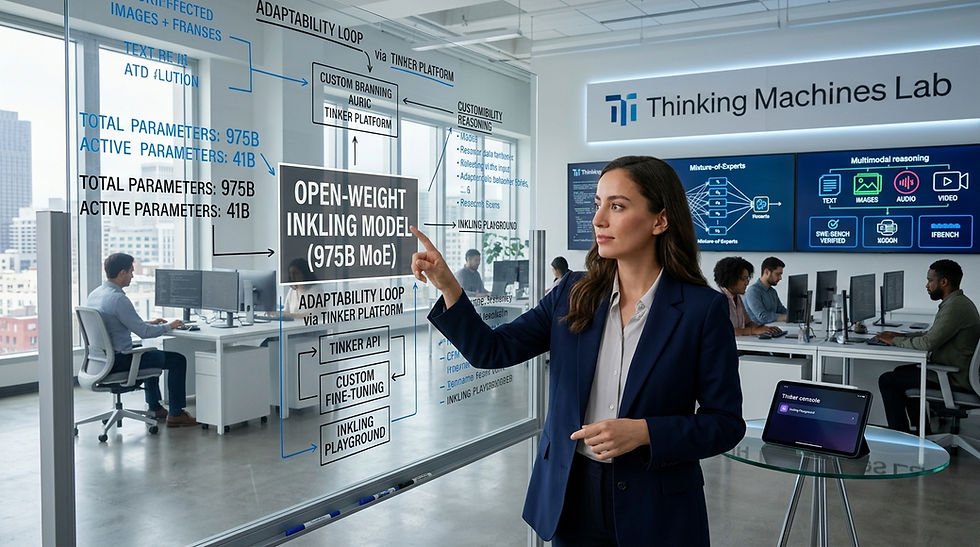
Inkling is a 66-layer decoder-only transformer with a sparse mixture-of-experts backbone, 975 billion total parameters with 41 billion active on any given token, routed through 6 of 256 experts plus two shared experts that fire on every token. It supports a context window of up to one million tokens and was pretrained on 45 trillion tokens spanning text, images, audio, and video. Inputs accept text, image, and audio; outputs are text only, including code and structured data.
Alongside the full model, Thinking Machines previewed Inkling-Small, a 276 billion parameter version with 12 billion active parameters, which the company says matches or exceeds its larger sibling on several benchmarks thanks to improvements in pretraining data and recipe. Its weights will follow once testing is complete. Notably, Inkling-Small carries the same total and active parameter counts, 276 billion and 12 billion, as TML-Interaction-Small from May, and coverage of the release describes Inkling's native audio and vision processing as feeding directly into the lab's broader push toward interaction models that can hold a live voice-and-video conversation. The foundation model work and the real-time collaboration research appear to share underlying architecture, even if Thinking Machines hasn't spelled out the exact relationship in its release materials.
The weights are open under an Apache 2.0 license and available on Hugging Face. Running the full BF16 checkpoint requires at least 2 terabytes of aggregate GPU memory; a quantized NVFP4 version brings that down to roughly 600 gigabytes. Inference partners including Together AI, Fireworks, Modal, Databricks, and Baseten offered day-zero hosted access, and the model has built-in support in vLLM, SGLang, and Hugging Face's transformers library.
A Deliberate Underdog Position
What sets Inkling apart from most flagship model launches is what the company chose not to claim. Thinking Machines states plainly in its own release materials that Inkling is not the strongest model available today, open or closed. On Terminal Bench 2.1, a coding benchmark, the company reports Inkling trailing GLM 5.2 by 18.9 points among open-weight peers, while claiming it uses roughly a third as many tokens as Nvidia's Nemotron 3 Ultra to reach comparable coding performance.
Those are self-reported figures from Thinking Machines' own benchmark tables, though some scores, including performance on FORTRESS Adversarial and VoiceBench, are drawn from Artificial Analysis, an independent evaluator.
The company's argument is that raw capability is becoming a commodity as open-weight models proliferate and efficiency gains compress the cost of running them, while the durable value sits in the layer where organizations adapt a base model to their own workflows and data. Inkling exists to be fine-tuned through Tinker rather than to win a benchmark chart on its own.
A controllable "thinking effort" setting, ranging from 0.2 to 0.99 and exposed as a parameter developers can set directly, lets teams trade latency for reasoning depth on a per-call basis rather than committing to one fixed operating point.
Hugging Face CEO Clem Delangue offered a version of the same thesis in comments to TechCrunch last week, predicting that frontier models will increasingly be reserved for experimentation and high-value tasks while most production AI work shifts toward private or open-source alternatives.
Thinking Machines is building its business around that exact split.
The clearest evidence the company has offered for the approach comes from a project with Bridgewater Associates, the world's largest hedge fund. Researchers from both firms took an open-source model and further trained it on Bridgewater's financial expertise, reporting a score of 84.7 percent on financial reasoning tests, ahead of top proprietary models, at roughly a fourteenth of the running cost. That result comes from a joint evaluation conducted by the two companies involved. It hasn't been independently audited, and should be read with that caveat attached.
Safety Testing and What's Still Unverified
Thinking Machines' model card describes safety evaluations covering both everyday interaction patterns, including sycophancy and parasocial dependency, and dangerous-capability testing for CBRN and cyber uplift, using refusal-suppressed variants to estimate latent risk with safeguards removed. The company concluded Inkling doesn't present uplift beyond what's already available in the open-weight ecosystem, while acknowledging the model can still be coaxed into compliance through role-play or indirectly framed prompts, a limitation it says is consistent with other open-weight models and best addressed with downstream moderation layers rather than the model's own refusals.
Several claims around the launch remain unverified by outside parties. Coverage has repeated Thinking Machines' assertion that Inkling delivers performance comparable to the leading Chinese open-weight models, currently considered the strongest in that category, but no independent benchmark run has yet tested that claim directly. Post-training also drew on synthetic data generated by Moonshot AI's Kimi K2.5, a detail Thinking Machines disclosed itself and that several outlets have noted without further scrutiny.
The Infrastructure Behind the Launch
Inkling arrives on the back of substantial capital commitments. Thinking Machines signed a multibillion-dollar Google Cloud deal in April, reported in the single-digit billions, giving it access to Nvidia's GB300 NVL72 systems through Google's A4X Max instances, alongside a separate, undisclosed investment from Nvidia tied to future hardware purchases. Training used a hybrid optimization approach, Muon for large matrix weights and Adam elsewhere, run on that GB300 infrastructure.
What Comes Next
Thinking Machines frames Inkling as the first entry in a model family rather than a finished product. Larger successors are reportedly already in training, and the company has said its openness strategy will likely be applied case by case. Murati was at OpenAI in 2019 when that lab withheld the full version of GPT-2 over misuse concerns, an early sign of the retreat from open releases that followed, and there's no commitment that every future Thinking Machines model will ship with open weights the way Inkling has.
For now, the more interesting throughline sits underneath the press release. A research preview built to test whether a model could listen, watch, and speak in real time, published as an interactivity benchmark exercise in May, has resurfaced two months later as the architecture underneath the company's first shipped foundation model. The capability got proven in a controlled setting first. What Inkling represents is that same underlying work now being handed to enterprises to fine-tune on their own infrastructure, which is a different kind of test entirely