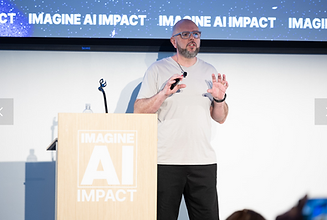
David Borish is an independent Enterprise AI Strategist, keynote speaker, and author based in New York. He created the Open-Prem Inflection Point framework, then partnered with IBM to deliver the Open-Prem Strategy Accelerator workshop, he advises Fortune 500 organizations on AI deployment, and serves as a Guest Lecturer and Mentor at New York University. He holds AI patents, has multiple successful exits, and 25 years of experience building at the edge of what's possible, from co-creating the first VR headset sold on television with Shark Tank's Daymond John to developing the first high-speed 360-degree camera technology and software which was adopted by the NFL and NRL.
His July 2024 prediction that China's AI capabilities would surge was widely dismissed until DeepSeek's emergence triggered significant market corrections months later, validating what he had been writing and speaking about across his platforms. Two years on, Chinese open-source models compete directly with the leading commercial systems, a shift his own research has tracked from the first signals through to frontier parity.
Borish is the founder of The AI Spectator, where he publishes daily analysis of the AI industry. His work has been featured in Forbes, MarketWatch, Morningstar, and The Canadian Press. He delivers keynotes at institutions including NYU, Cornell, IBM, and conferences worldwide.
He is the author of "The Tony Hawk Paradox," a book exploring simulation theory through the lens of how video game tricks became real-world reality. It is the kind of question that sits at the intersection of everything he has spent his career thinking about: technology, culture, and the moments where the impossible becomes inevitable.


PRESS




THE OPEN-PREM INFLECTION POINT V4
The Open-Prem Inflection Point V4 tracks when running AI on your own infrastructure becomes a practical alternative to renting it from a cloud provider. Now in its fourth edition, the framework was created by David Borish to help enterprise leaders evaluate open-weight model performance and licensing, hardware economics, agent security, compliance timelines, and AI-built software. Against low-cost open-model APIs, the case for self-hosting rests on control rather than token savings.
Released: October, 2026